Chess pawn structures: the 25 that decide the middlegame
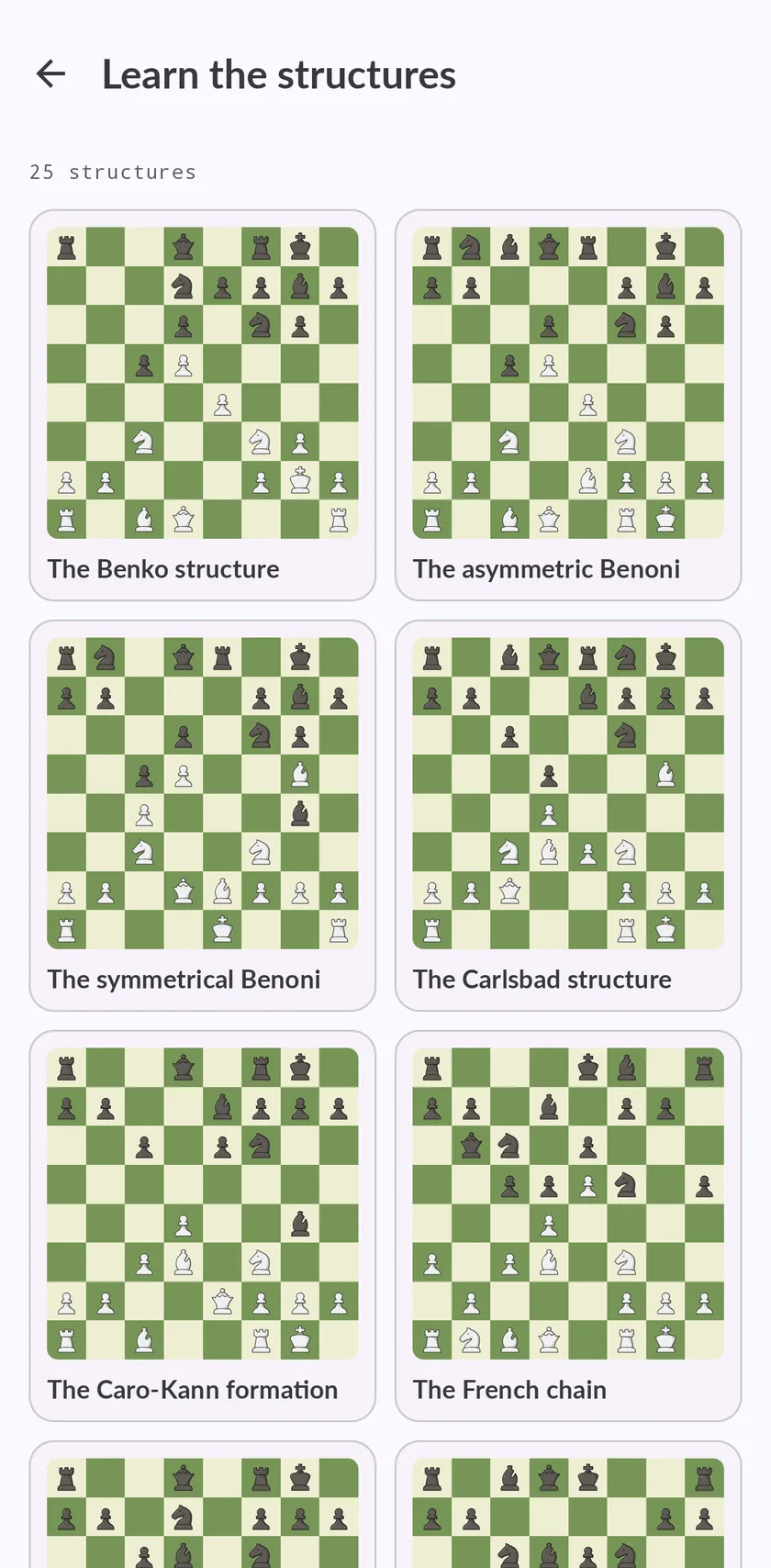
When the opening theory runs out, the pawns tell you what to do. Each structure comes with its own plans, breaks and good squares, and recognising it is half of finding the right move. Here are the 25 that Chess Coach teaches, and how to practise them.
Why pawn structures matter
Pieces move around; pawns stay. The pawn structure decides which files open, which squares your pieces can use for good and where each side should attack. Two positions from different openings with the same structure usually want the same plan, which is why strong players think in structures rather than in move orders.
The 25 structures
| Structure | How to recognise it |
|---|---|
| The Benko structure | Black plays with no pawns on the a- and b-files. |
| The asymmetric Benoni | A white pawn on d5 locked against the black pawn on d6, with c5 beside it and a black bishop fianchettoed on g7. |
| The symmetrical Benoni | White pawns on c4 and d5 against Black's on c5 and d6, with the d-file locked. |
| The Carlsbad structure | White with pawns on d4 and e3 and a kingside majority; Black with c6, d5 and a queenside majority. |
| The Caro-Kann formation | White pawns on c3 and d4, Black pawns on c6 and e6. |
| The French chain | Two pawn chains locked head to head. |
| The traded centre in the French | White pawns on c3 and d4, Black pawns on c6 and d5, and the e-pawns already traded. |
| The French with f6 | An isolated white pawn on d4 against d5, while Black has no f- or c-pawn: a half-open f-file and a lone pawn on e6. |
| The Grünfeld centre | White pawns on c3, d4 and e4, with no white pawn left on the b-file. |
| Hanging pawns | Two pawns side by side on c5 and d5, no neighbours and nothing in front of them. |
| The Hedgehog | Black pawns on a6, b6, d6 and e6, no c-pawn, and the castled pawns untouched on f7, g7 and h7. |
| The isolated queen pawn | A pawn on d4 with no neighbours on the c- or e-files, facing a black pawn on d5 or an empty square. |
| The small c6 and d6 centre | White has pawns on c4 and e4 and none on the d-file; Black has c6 and d6 and none on the e-file. |
| The open centre after the trade | A black pawn on e5 facing White's c4 and e4 pawns, with the d-file empty of pawns. |
| The d5 against e5 chain | White pawns on c4, d5 and e4 against black pawns on c7, d6 and e5. |
| The e5 and f5 duo | A locked centre, d5 against d6: Black has the d6–e5 chain and a pawn on f5. |
| The race on both wings | A locked centre, d5 and e4 against d6 and e5, with the c-pawns traded: Black pushes on the kingside, White on the queenside. |
| The majority that makes a passer | One side has more pawns on one wing than the other. |
| The Maróczy bind | White pawns on c4 and e4 that take b5 and d5 away from Black. |
| The d5 wedge | A white pawn on d5 locked against Black's d6 pawn, with another black pawn on e5. |
| The Scheveningen small centre | Black keeps the pawns on d6 and e6 side by side and unadvanced. |
| The d5 square in the Sicilian | Black has pawns on d6 and e5 and has already traded the c-pawn. |
| The Slav formation | White has d4 and e3 and is left with no c-pawn. |
| The Closed Spanish | White pawns on c3, d3 and e4; Black pawns on a6, b5, c5, d6 and e5. |
| The Stonewall | Pawns on c6, d5, e6 and f5 forming a wall on the light squares. |
How to practise them in Chess Coach
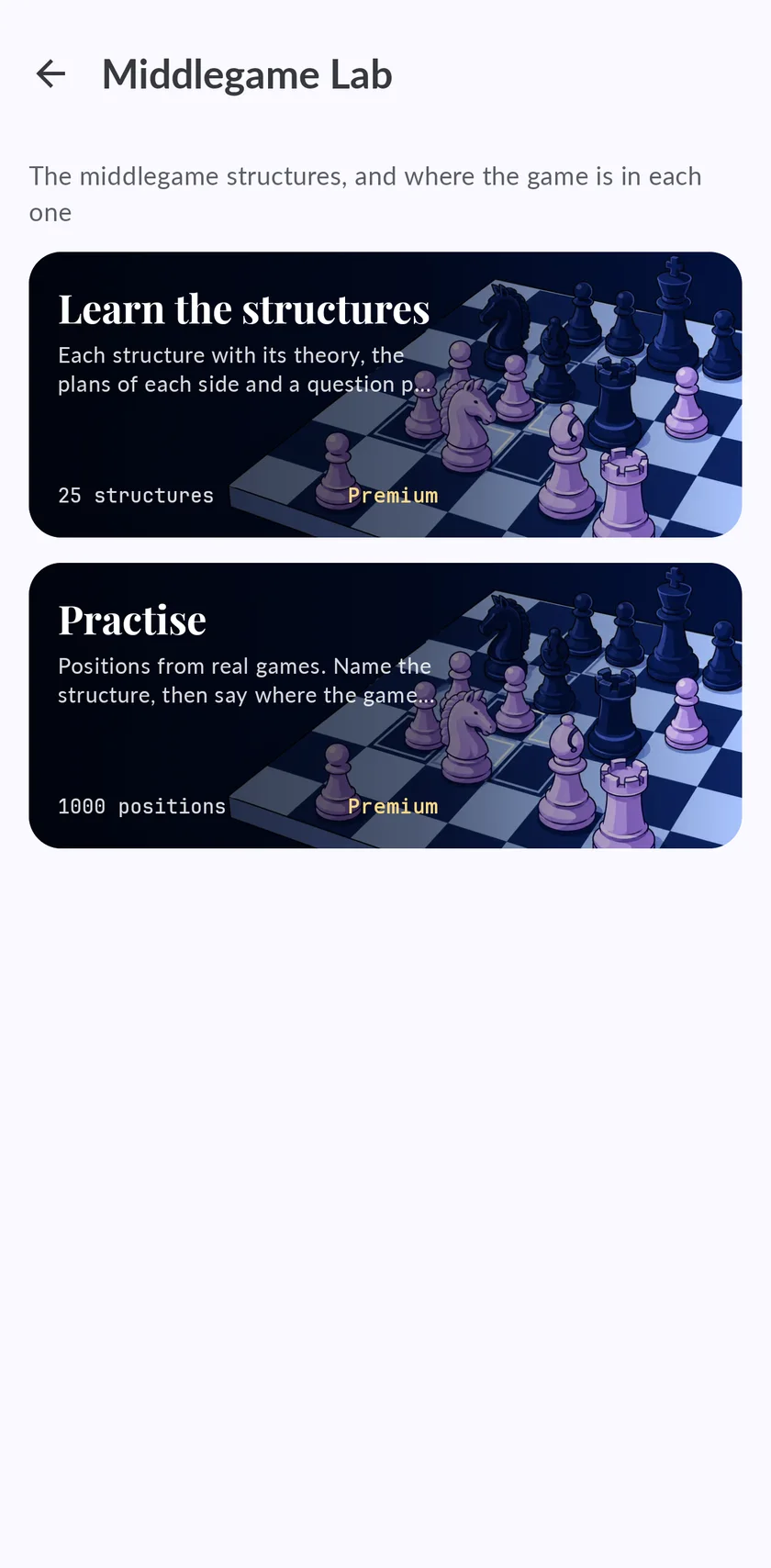
- Learn the structure. Each one comes with its theory, the plans for White and for Black, and a question for each side to check you read it right.
- Recognise it in real games. The practice mode shows positions from real games: you name the structure and say where the game is heading.
- Play it. In each structure you can play a normal game from the diagram, as White or as Black, against a rival who moves like a real player.
What is free
The d5 square in the Sicilian is free: its theory, its questions, a game from the diagram with either colour, and its 400 tactics. The practice mode and the other twenty-four structures are Premium.
Questions
What are the most important pawn structures in chess?
What is the plan against an isolated queen pawn?
Do I need to know openings to understand structures?
Keep training
Take the coach with you
Start free on iPhone, iPad or Android. No ads, and no subscription needed to play, analyse or take the first course.
Sign in and your games, ratings and progress follow you to the other device.
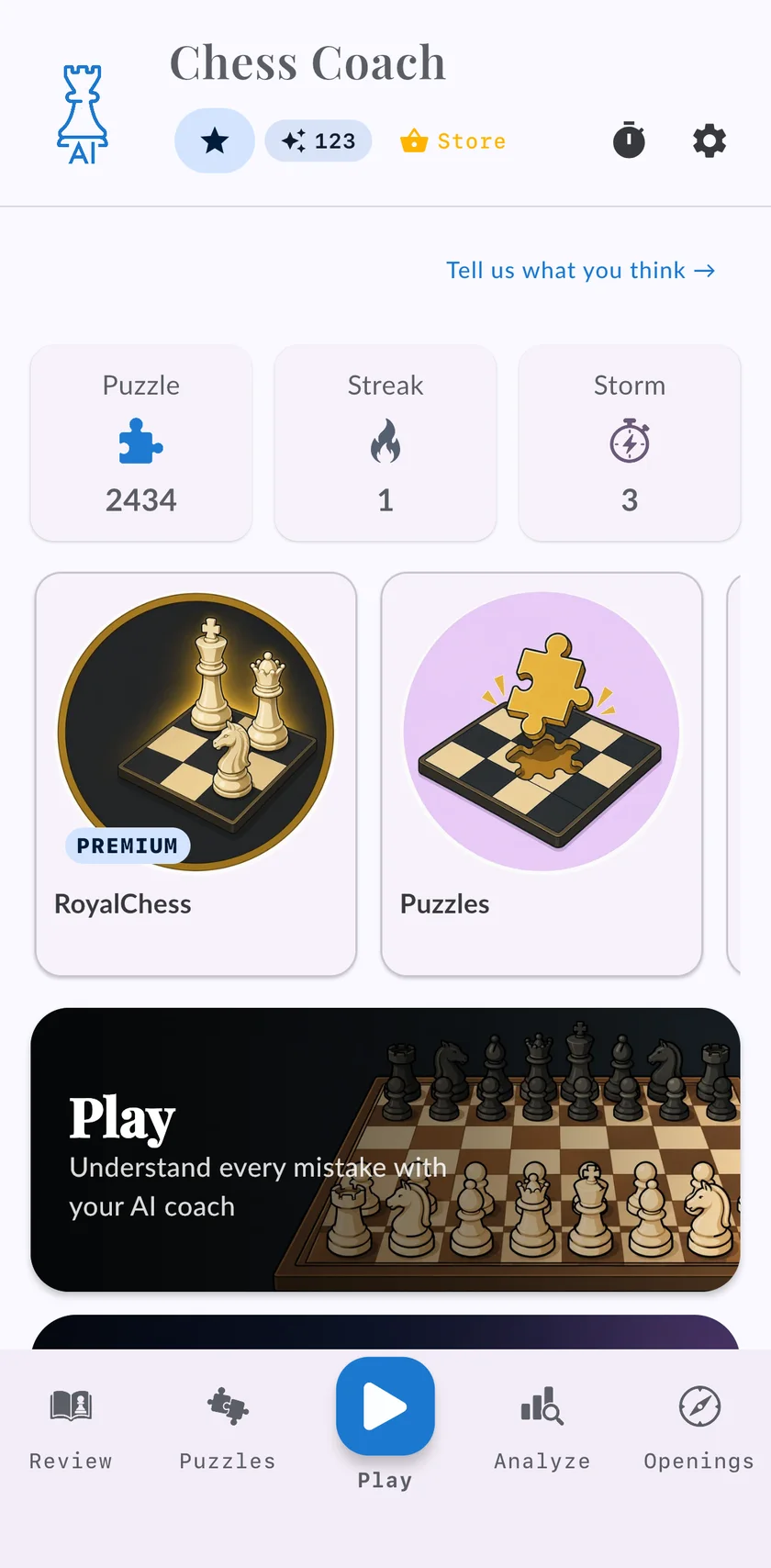
The home screen, on an iPhone. Same app on Android and iPad.